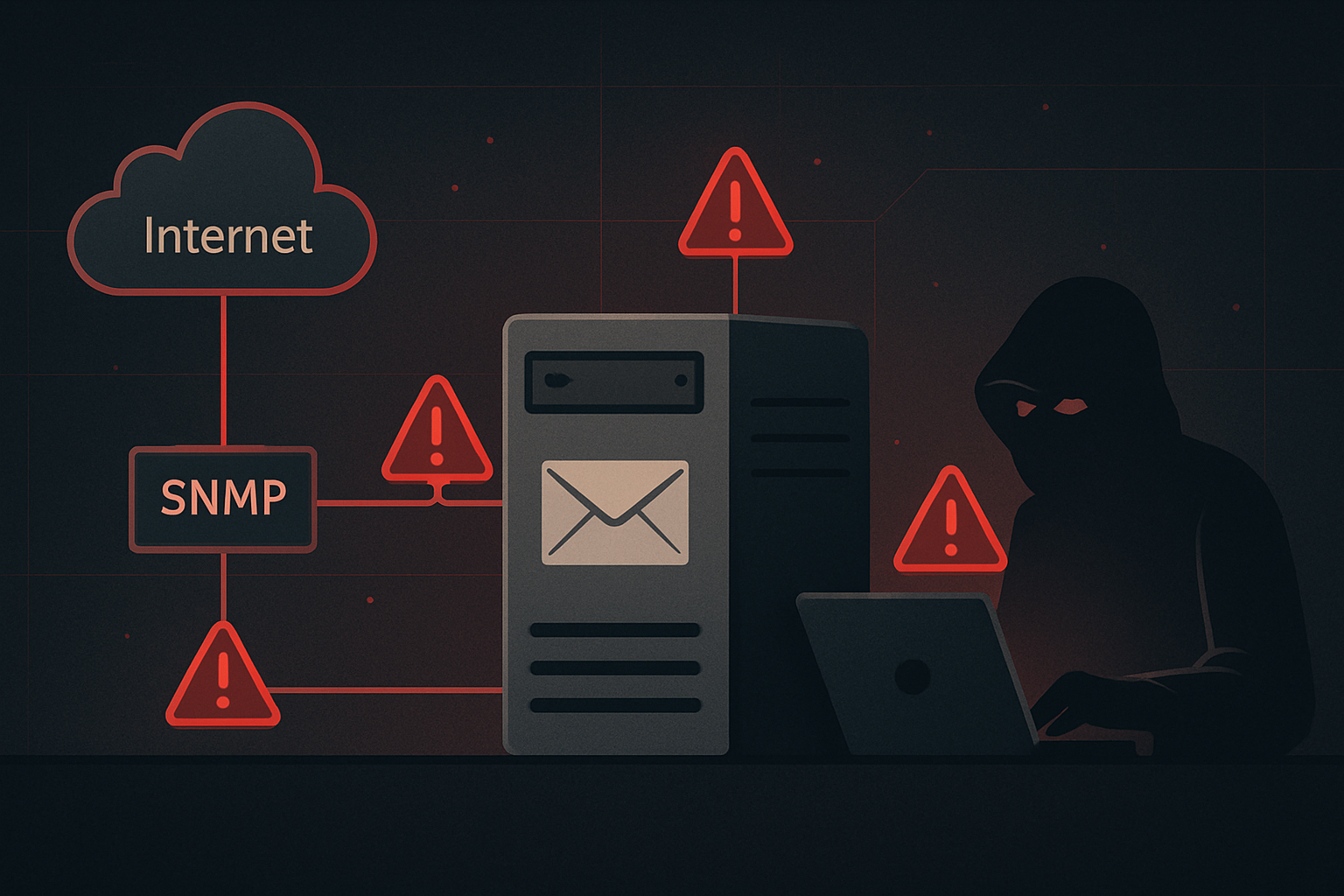
A critical vulnerability in Zimbra Collaboration Suite has been actively exploited in the wild to deploy web shells and exfiltrate authentication credentials from mail systems. The flaw, tracked as CVE-2026-73570 with a CVSS score of 8.9, represents a significant risk to organisations running Zimbra infrastructure, particularly those managing mail services for multiple tenants or sensitive workloads.
The Vulnerability and Attack Chain
CVE-2026-73570 is an unauthenticated operating system command injection flaw accessible via the Simple Network Management Protocol (SNMP) interface in Zimbra Collaboration Suite. The vulnerability permits remote code execution without prior authentication, meaning an attacker with network access to the SNMP service can execute arbitrary commands on the underlying operating system with the privileges of the Zimbra process.
In observed attacks, threat actors have leveraged this flaw to plant web shells—persistent backdoors that allow continued access to the compromised system. Beyond shell deployment, adversaries have systematically harvested authentication secrets, including session tokens and credentials stored in mailbox metadata. These secrets can then be repurposed to access legitimate user accounts, bypass multi-factor authentication mechanisms in some configurations, and move laterally within the organisation's infrastructure.
What makes this particular exploitation chain dangerous is its speed of execution. From initial compromise to web shell placement and credential exfiltration, the entire process can complete in minutes—far faster than most organisations' detection and response windows.
Exposure and Network Architecture Implications
SNMP is traditionally considered an internal-only service and is often left exposed on networks where administrators assume implicit trust. However, many organisations have SNMP enabled on Zimbra instances accessible from the internet, either through misconfigured firewalls or because mail infrastructure has been placed in DMZ segments where it touches untrusted networks.
Organisations running Zimbra should audit their network topology immediately. SNMP services should be restricted to monitoring and management networks only, with explicit firewall rules that deny access from untrusted sources. If SNMP is not required, disabling it entirely is the safest approach. For those who must run SNMP for legitimate operational monitoring, community strings should be changed from defaults (public/private), access control lists should be tightened, and SNMPv3 with authentication and encryption should be deployed instead of SNMPv1 or SNMPv2c.
Patch Status and Immediate Actions
Zimbra has released patches for this vulnerability. Infrastructure operators should prioritise applying updates across all Zimbra instances. However, patching is not instantaneous—organisations often need time to test updates in non-production environments, coordinate maintenance windows, and manage dependencies.
Whilst patches are being prepared and deployed, interim measures are essential. Network segmentation is the most reliable temporary control: ensure that only authorised administrative hosts can reach the SNMP service. Monitor for suspicious SNMP requests, particularly those containing shell metacharacters or commands. Check for existing web shells using filesystem integrity monitoring or anomalous file timestamps in web-accessible directories.
Organisations should also assume breach and review recent mailbox access logs, especially for privileged accounts. Look for authentication events from unusual IP addresses or with abnormal patterns. If credentials have been exfiltrated, password resets may be warranted, particularly for accounts with high privilege levels.
Lessons for Infrastructure Design
This incident reinforces several core principles of secure infrastructure operation. First, services that should never be internet-facing must be explicitly treated as such—isolated behind firewalls with default-deny rules. Second, even if a service appears to require authentication at the application layer, underlying protocol vulnerabilities can bypass those controls entirely. Third, the assumption that internal-use protocols like SNMP are inherently secure is a common and costly mistake.
Detailed analysis of the Zimbra exploitation campaign shows that threat actors identified and weaponised this flaw rapidly. This underscores the importance of proactive vulnerability scanning, patch management discipline, and monitoring infrastructure that catches anomalous behaviour before attackers can consolidate access.
For organisations operating mail infrastructure at scale—whether providing services to customers or managing internal deployments—this vulnerability is a reminder that the boundary between internal and external networks continues to blur. Treating every service with external reachability as potentially exposed, and architecting accordingly, remains the most reliable defence.