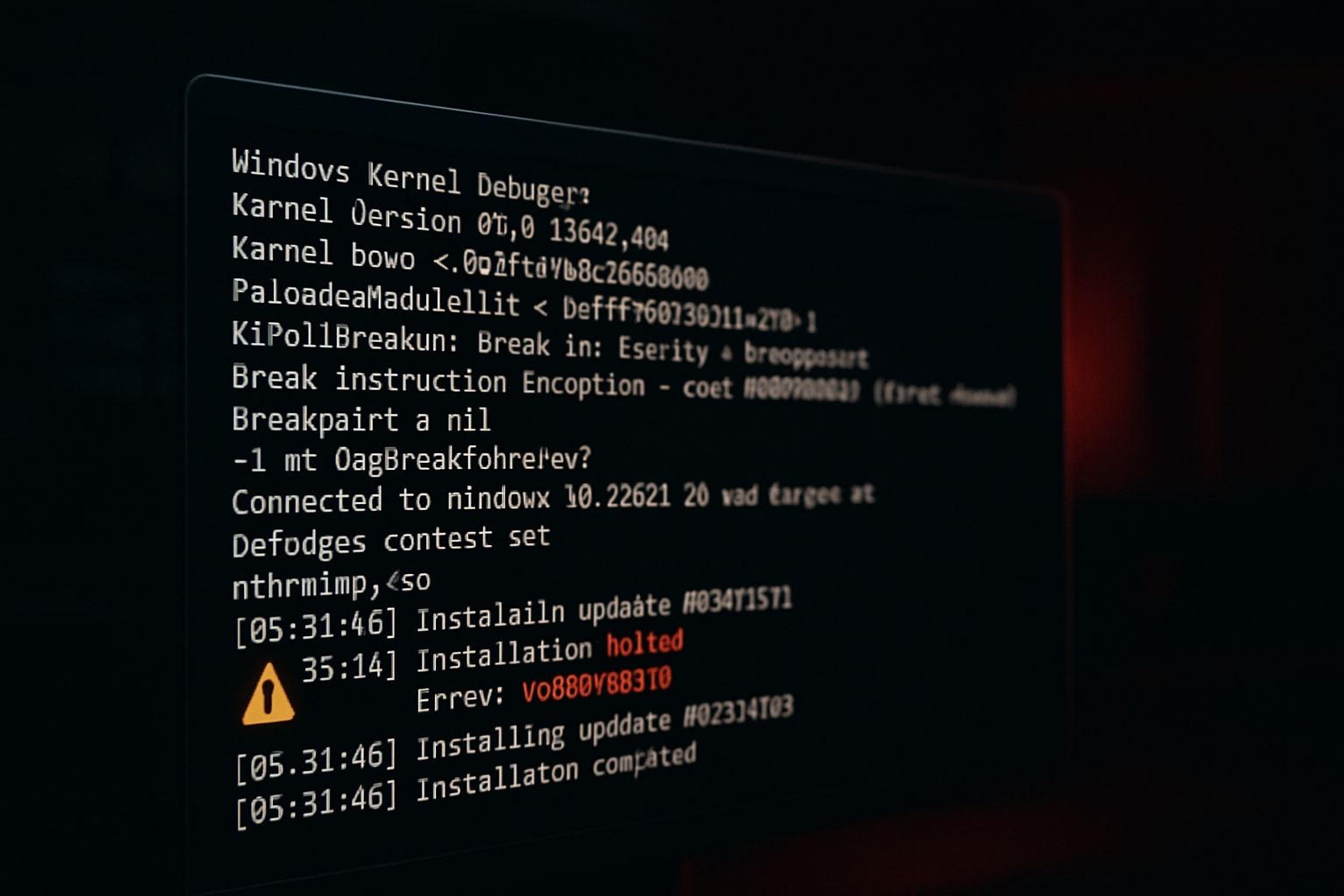
Microsoft's August 2026 security release addressed 398 vulnerabilities, but one stands out for infrastructure operators: a kernel-level privilege escalation in a core Windows driver that handles network socket operations. Unlike most patches released retroactively, this flaw—tracked as CVE-2026-68820 with a CVSS score of 7.0—is already under active attack, making rapid patching essential for anyone managing Windows-based hosting environments.
The Attack Chain and Exploitation Model
The vulnerability resides in a fundamental Windows component: the kernel driver responsible for socket operations. An attacker who has already achieved code execution on a target machine—through a separate initial compromise—can exploit this flaw to escalate privileges to SYSTEM level. This is a classic post-exploitation technique: once an attacker gains a foothold (perhaps through a web application vulnerability, social engineering, or another vector), they use a kernel driver bug to break out of a restricted context and obtain full system control.
The confined scope—requiring pre-existing code execution—means this is not a worm-like threat that can propagate across a network unaided. However, for hosting environments where customer-facing applications run with elevated privileges or where VM escape is a secondary concern, the presence of active exploitation adds urgency. An attacker who compromises a single customer account or application can use this flaw to move laterally, access the host system, or pivot to other tenants if isolation boundaries are insufficient.
Implications for Hosting Infrastructure
For dedicated server and VPS providers operating Windows infrastructure, this vulnerability demands immediate attention. The flaw affects a core kernel driver, meaning it applies across Windows Server editions and consumer Windows versions alike. Any system still running an unpatched kernel is exposed if an attacker achieves initial code execution—a scenario that occurs regularly in production environments through exploited web applications, SQL injection, or compromised third-party software.
The timing is particularly relevant: according to reports of the patch release, active exploitation is already occurring in the wild. This means attackers have reverse-engineered the vulnerability or received it through threat intelligence, and are actively targeting unpatched systems. Hosting providers cannot assume a grace period before attacks arrive; they should treat this as already present in their threat model.
Patching Priorities and Operational Considerations
Windows Server patching presents operational challenges that consumer systems do not face. Reboots are disruptive, downtime affects multiple customers, and coordinating updates across clusters requires careful scheduling. However, a kernel-level flaw under active attack justifies prioritisation over routine maintenance windows.
A sensible approach involves segmenting infrastructure by risk profile. Servers hosting untrusted customer code, exposed web applications, or internet-facing services should be patched first. Internal management infrastructure and isolated application servers can follow in a secondary wave. For providers offering managed services, communicating the requirement to customers and offering a patching window—or applying patches unilaterally if SLAs permit—should be the immediate next step.
Testing the patch in a non-production environment before broad rollout remains prudent, but given active exploitation, extended testing cycles should be compressed. A kernel driver update carries low risk of application incompatibility compared to, say, a major OS version upgrade; the risk of leaving the system unpatched outweighs the testing burden.
Broader Lesson: Kernel-Level Flaws and Isolation
This incident reinforces a long-standing principle in infrastructure design: kernel-level vulnerabilities erode the boundary between privilege levels. A flaw in socket operations—seemingly innocuous—becomes a privilege-escalation weapon when exploited by an attacker already running code on the target. For hosting operators, this argues for defence in depth: assuming that some workloads will be compromised, and ensuring that kernel-level isolation (hypervisor, container runtime, network segmentation) prevents an attacker from using a single compromised VM or account to breach the entire infrastructure.
For now, the remediation is straightforward: apply the August 2026 Microsoft security update across all Windows infrastructure, prioritising externally facing and customer-hosted systems, and monitor logs for evidence of exploitation attempts. The combination of active attacks and kernel-level access makes this a candidate for emergency patching rather than standard maintenance scheduling.