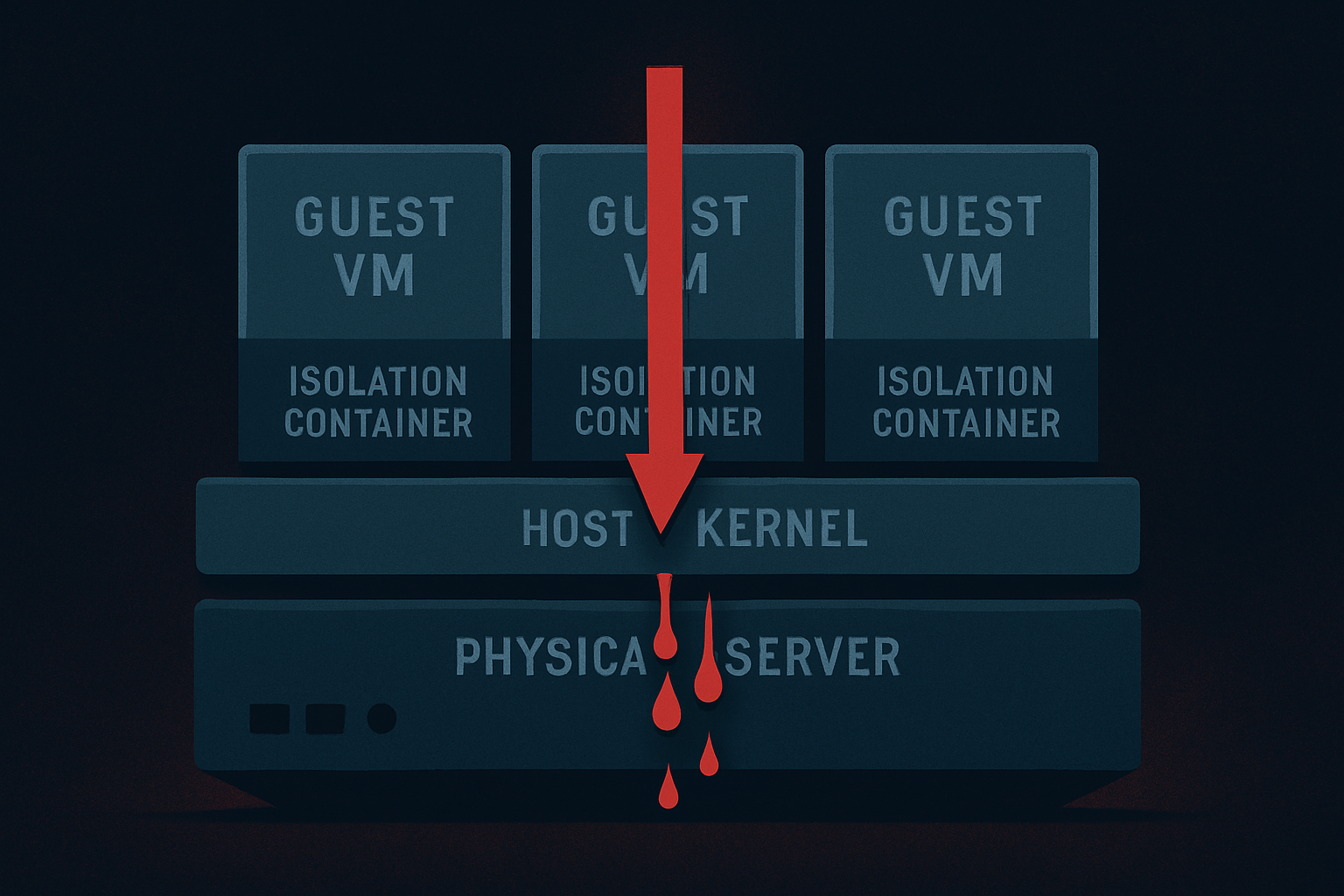
A critical vulnerability in the Linux kernel's networking stack has surfaced that undermines one of virtualisation's most fundamental security promises: memory isolation between guest systems and the physical host. Tracked as CVE-2026-99999 and called PwnEscape, the flaw permits unprivileged code running inside a virtual machine to directly read memory from the host kernel and other guest systems sharing the same hardware.
The Isolation Assumption Has Broken
Hosting and cloud infrastructure operators have long relied on the Linux kernel to enforce strict boundaries between virtualised environments. A guest VM should never be able to access memory belonging to the host or to sibling VMs on the same physical server. This isn't merely a performance optimisation or convenience—it's the foundational security model that makes shared hosting and VPS offerings economically viable and operationally safe.
PwnEscape tears open a hole in that model by exploiting a flaw in the kernel's networking code that doesn't properly validate memory access from certain contexts. A researcher demonstrated the vulnerability against production sandbox environments, proving the attack works in real-world configurations. Because the flaw sits in core kernel code rather than in any individual cloud provider's orchestration layer, every hosting operator running Linux-based virtualisation is potentially affected, regardless of their specific setup or isolation technology.
Why Kernel Flaws Are Particularly Dangerous in Hosting
Unlike application-level vulnerabilities, which can sometimes be contained or mitigated at a single layer, kernel flaws affect the entire stack. A guest VM running on your server doesn't need to exploit a misconfiguration in your hypervisor or orchestration system—it can bypass those layers entirely by abusing the kernel itself. This is especially serious for hosting providers because the guest workload is often untrusted or semi-trusted code running on infrastructure you operate and are responsible for.
The networking subsystem is a particularly sensitive target because it handles data from external sources and processes it with elevated privileges. If an attacker can craft specific network packets or trigger certain code paths in the kernel's network stack from within a guest, they can potentially trigger memory disclosure. Sensitive data—cryptographic keys, credentials, data from other customers' VMs—could all be exposed.
Immediate Steps for Infrastructure Operators
Hosting operators should prioritise a kernel update as soon as patches become available. Waiting for the next maintenance window is not advisable; this vulnerability's severity warrants expedited patching. Coordinate with your hypervisor vendor (KVM, Xen, or your custom stack) to confirm patch compatibility and any additional measures needed.
In the interim, consider tightening guest VM capabilities and seccomp profiles to restrict access to sensitive networking syscalls where feasible. Network isolation between guests (vlan tagging, separate bridges) won't stop the kernel-level leak, but defence-in-depth measures may reduce attack surface. Monitor kernel changelogs and security advisories closely; PwnEscape will likely spawn follow-up disclosures or related techniques as the research community examines the networking code further.
If you offer dedicated servers or bare-metal instances, the risk is lower but not zero—guest code can still interact with the host kernel through containers or lightweight virtualisation. Offshore or privacy-focused hosting providers should be especially cautious, as they're often targets for both technical exploitation and legal pressure; an unpatched kernel vulnerability adds unnecessary risk to an already sensitive operational posture.
The Broader Lesson
PwnEscape underscores a hard truth: virtualisation isolation is only as strong as its weakest component, and the kernel is not a negligible component. Even mature, widely-audited code can harbour critical flaws. Operators cannot assume that kernel hardening alone will catch every issue; active patching cycles, vulnerability monitoring, and layered isolation strategies are non-negotiable. Customers of shared hosting and VPS services deserve to know that their providers treat kernel updates with the urgency they deserve.