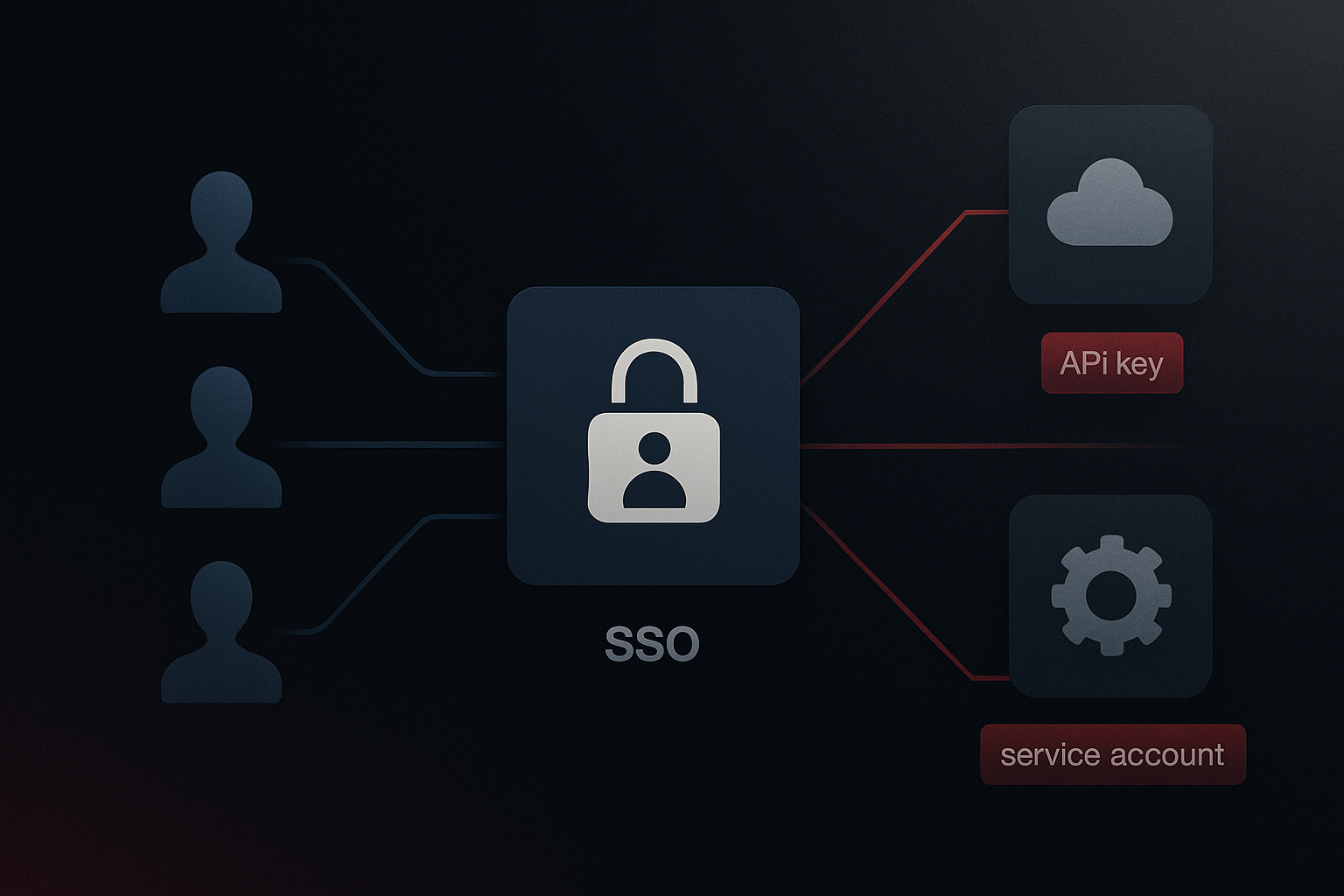
The assumption that your single sign-on system and identity stack govern all user access to your infrastructure is increasingly unreliable. A significant proportion of the third-party tools integrated into hosting environments, SaaS platforms, and on-premises infrastructure now include embedded AI agents that bypass traditional authentication entirely — not through deliberate evasion, but because they were designed to operate independently of the identity layer.
The Scale of the Visibility Gap
Recent security research reveals that approximately 1,280 third-party products embed AI agents. Of those, roughly 282 sit behind single sign-on systems where identity teams can theoretically audit and control their use. The remaining thousand operate in what might be called the identity blind spot: they authenticate directly to backend services, use embedded credentials, or rely on API keys provisioned outside the identity management workflow.
This isn't a conspiracy. Most of these agents were built before anyone thought to ask whether they should authenticate through a company's identity provider. They operate in the gaps that identity infrastructure wasn't designed to fill. A third-party monitoring tool, a vendor's automated support agent, a SaaS product's internal AI that processes your data — these typically connect using service accounts, static credentials, or long-lived tokens that sit outside your SSO perimeter.
For infrastructure operators, the implication is straightforward: you cannot assume that an audit of your active directory, Okta, or similar system gives you a complete picture of what has access to your systems.
Why Identity Infrastructure Doesn't Help
Identity and access management systems are built around human users and their sessions. A person logs in through SSO, gets a token, and accesses resources. The identity stack can revoke that token, enforce MFA, log the session, and track usage. All of this happens because authentication happens through a known system.
An AI agent embedded in a third-party product bypasses this model entirely. It doesn't log in as a user. It connects using a service principal, a static API key, or credentials baked into the product configuration. From the perspective of an identity governance team, the agent doesn't exist. They can't enforce conditional access policies on it, can't require MFA, can't easily revoke its permissions, and can't audit its activities through the identity system.
This creates a secondary infrastructure layer that operates parallel to your primary access controls. The more third-party integrations you use, the more of these invisible agents accumulate. Each one represents a potential surface for compromise: if a third-party vendor is breached, if an agent's credentials are exposed, or if a vendor undergoes a supply-chain attack, your infrastructure may be affected without your identity team ever seeing it happen.
The Scope for Infrastructure Teams
Operators running hosting environments, dedicated servers, or multi-tenant infrastructure should treat this as a separate risk vector from user access control. The standard response — ensuring that users authenticate through a central identity provider — solves only part of the problem. You also need to understand what agents exist, where their credentials live, and what permissions they hold.
A practical starting point is to audit third-party integrations by type. Identify which ones include AI or autonomous decision-making capabilities. Check whether they authenticate through your identity system or use embedded credentials. If they use embedded credentials, understand what permissions those credentials hold and whether they can be revoked or rotated independently. Some cloud providers and identity vendors have begun adding agent-aware features to their platforms, but these are still emerging and not universal.
For those running offshore or privacy-focused infrastructure where credential management and regulatory oversight may be lighter, the risk becomes more acute. The absence of strict identity governance doesn't eliminate the threat posed by third-party agents — it simply means the risk is less visible and less controlled.
Moving Toward Visibility and Control
The longer-term fix requires both vendors and operators to rethink how agents authenticate. Some vendors are beginning to offer agent-aware identity integration, where an AI agent can authenticate through your existing identity provider rather than using static credentials. This is not yet standard practice, but it's a direction worth pushing for.
Until that becomes common, your best strategy is to maintain a separate inventory of third-party agents and their access rights, ideally separate from your primary identity audit. Rotate credentials regularly, apply principle of least privilege even to third-party integrations, and consider segmenting infrastructure so that a single compromised third-party credential doesn't grant access to your entire environment.
The third-party agent problem reflects a real gap in how modern infrastructure is secured. Your identity stack is designed to govern human access. Most AI agents operate outside that model. Bridging that gap requires operators to acknowledge the limitation and build additional controls to compensate.