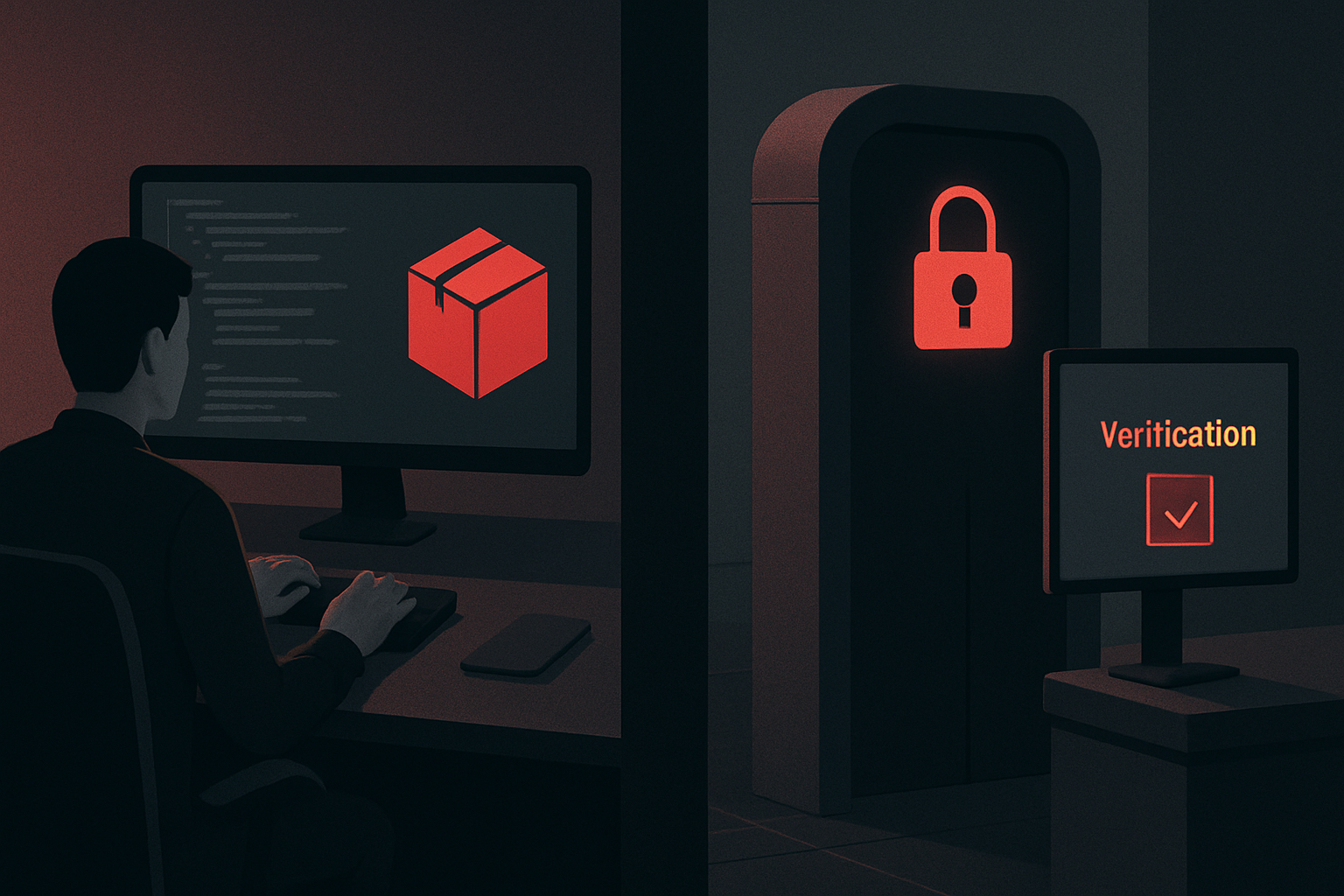
The software supply chain has become a reliable attack vector. Compromised build systems, stolen credentials, and insider threats have all leaked malicious code through package registries into production environments. npm's introduction of staged publishing—a feature that gates release approval behind mandatory 2FA—represents a shift toward explicit human sign-off at the infrastructure boundary.
How Staged Publishing Changes the Release Flow
Staged publishing separates the act of uploading a package from making it publicly available for installation. A maintainer can prepare a release and push it to npm's servers, but the package remains hidden from npm install queries until an authorised person completes a 2FA challenge and explicitly approves it.
This two-phase model matters because it introduces a checkpoint. Under the old model, credential theft or a compromised CI/CD pipeline could publish malicious code directly and immediately. By the time a maintainer noticed, thousands of installations might already have pulled the bad version. With staged publishing, an attacker or rogue process still needs to clear a second, out-of-band authentication event to flip the release live.
The control is particularly valuable for high-impact packages—widely-used libraries where a single compromised release can ripple across the ecosystem. Popular maintainers can now require that any release, even automated ones, waits for explicit human approval.
The Approval Gate as Infrastructure Practice
What makes this noteworthy for infrastructure teams is the principle: approval gates work. The concept is not new—banks have required dual control over sensitive operations for decades. Kubernetes, container registries, and deployment systems all benefit from sign-off workflows at critical junctures.
npm's implementation acknowledges a hard truth: automation alone does not prevent all attacks. A well-configured CI/CD pipeline can be broken into. A package maintainer's laptop can be compromised. But requiring a second, distinct authentication factor—especially one that goes to a different device or requires a time-sensitive response—raises the bar significantly. An attacker now needs either two separate credentials, or the ability to intercept a live 2FA prompt.
The trade-off is friction. Approval gates slow down release velocity. Maintainers must be available to approve each release, or releases queue. For high-frequency updates, this can become cumbersome. However, for critical packages, that slowdown is a feature, not a bug.
Broader Implications for Dependency Security
This feature is one piece of a larger picture. npm's new controls also include install-time restrictions, allowing maintainers to limit which versions or configurations are eligible for download. Combined with 2FA-gated publishing, these tools begin to address a fundamental asymmetry: developers depend on packages they did not write, with limited visibility into how those packages are maintained or released.
For teams running their own package infrastructure—whether a private npm registry, a Python package index, or a container registry—the lesson is clear. Gate approval workflows at the release boundary, require authentication factors separate from CI/CD credentials, and log every approval. This is not a panacea against supply chain attacks, but it is a measurable increase in resilience.
Practical Considerations
The staged publishing feature will see the most benefit in scenarios where maintainers are few and releases are deliberate. Smaller projects with one or two active contributors can enforce this easily. Large, fast-moving ecosystems may struggle with the process overhead unless they invest in automation—for example, automated tooling that checks test results and security scans, then files an approval request awaiting human review.
Organisations deploying applications that depend on npm packages should also evaluate their own intake controls. If your build pipeline pulls the latest version of a dependency without review, approval gates at the registry level offer limited protection. Dependency scanning, lock files, and staged rollouts in production all remain essential.
The npm staged publishing feature shows that infrastructure-level controls—approval gates, mandatory 2FA, and audit trails—remain one of the most effective defences against supply chain compromise. Not perfect, but materially harder to attack than the alternative.