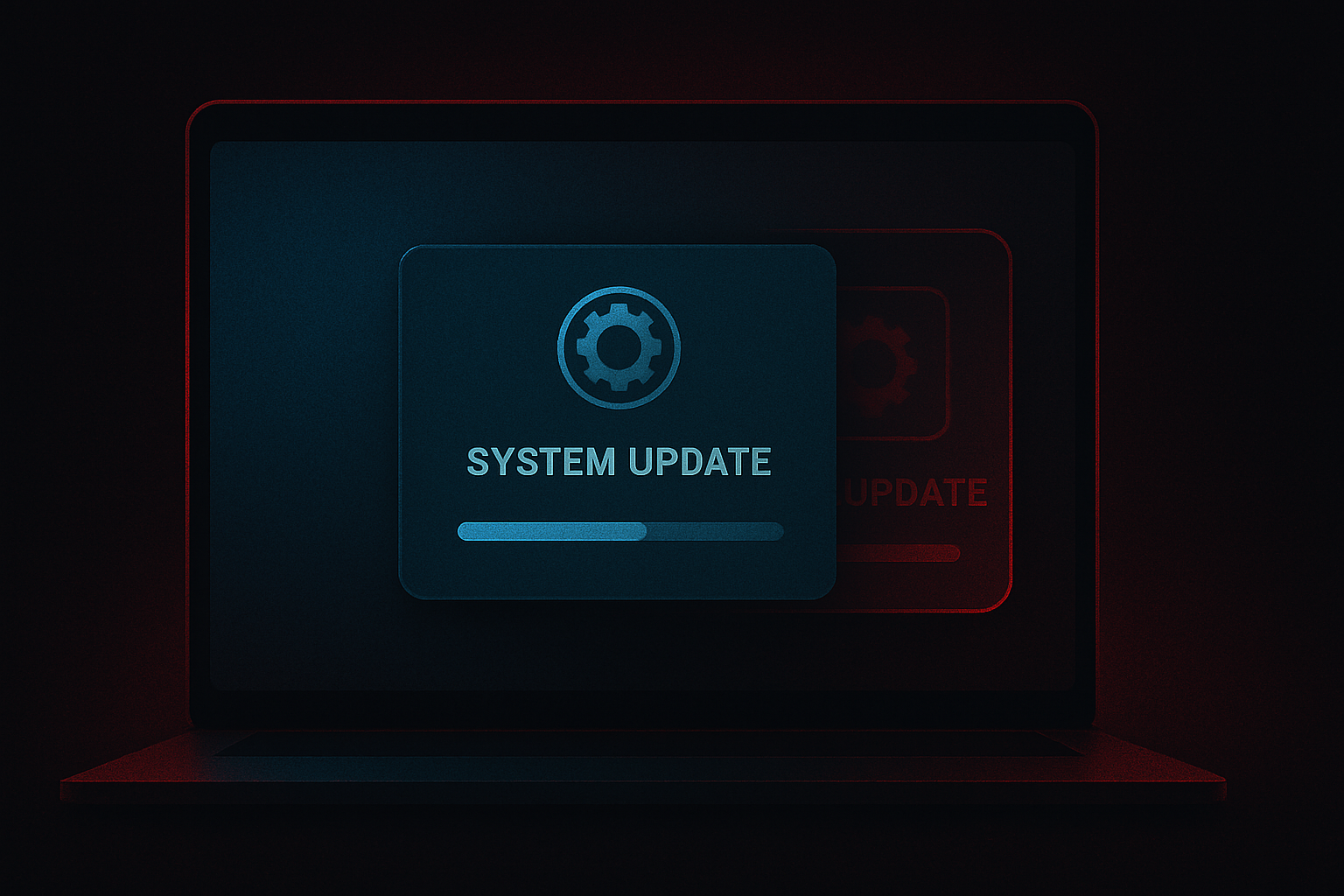
A sustained malvertising campaign attributed to North Korean threat actors has resurfaced with a refined approach to compromising macOS systems. The attack relies on a social engineering technique that mimics the familiar macOS update notification—a moment when users are conditioned to trust system prompts and provide administrative access. Understanding this campaign's mechanics is essential for anyone running services that could be targeted, particularly those handling cryptocurrency transactions or storing sensitive credentials.
The Fake Update Attack Surface
The campaign, an extension of what researchers call the Contagious Interview operation, begins with malvertising—fraudulent advertisements redirecting users to attacker-controlled pages. Once a user lands on one of these pages, they encounter a full-screen overlay that replicates macOS's native update interface with sufficient fidelity to bypass initial user suspicion. The overlay presents a mock update sequence, complete with progress bars and system-level styling, and prompts the user to enter administrator credentials or grant permission to install a package.
What distinguishes this approach from simpler phishing attempts is the attention to visual authenticity. macOS users have been trained through years of legitimate system updates to recognize and trust these prompts. By reproducing that interface faithfully, attackers exploit muscle memory and institutional trust in the operating system itself.
Payload and Infrastructure Implications
The malware delivered through this campaign has been designed to target cryptocurrency holdings. Once installed, it can steal private keys, wallet credentials, and transaction data. For infrastructure operators—particularly those running cryptocurrency exchange nodes, payment processors, or services that interface with blockchain applications—this threat extends beyond individual endpoint compromise. A single infected operator or administrator with privileged access to a hosting environment or network segment could provide attackers with lateral movement opportunities or direct access to sensitive systems.
The use of North Korea-linked infrastructure and tactics also suggests a coordinated, well-resourced campaign with persistence. These actors have demonstrated the ability to maintain operations over extended periods, adapt techniques when defences improve, and target multiple vectors simultaneously.
Detection and Mitigation Approaches
Traditional signature-based detection struggles with convincing fake update screens because the malicious element is primarily social—the visual trick itself—rather than binary code that can be easily fingerprinted. However, several technical controls can reduce exposure:
- Monitor DNS and network traffic for redirects to suspicious domains, particularly those mimicking Apple's infrastructure or update servers.
- Implement browser isolation or sandboxing for users who visit untrusted advertising networks or less-controlled corners of the web.
- Enforce strict code-signing verification policies and restrict administrative approval prompts to scenarios where users explicitly initiated system operations.
- Maintain up-to-date endpoint detection and response (EDR) tools capable of identifying unusual process execution patterns or credential-access attempts following update-like prompts.
For organisations handling cryptocurrency or operating in sensitive jurisdictions, endpoint security must be layered. A single compromised workstation can unravel security perimeters that took years to establish.
Broader Campaign Context
This latest iteration of the Contagious Interview campaign reflects a pattern seen in state-sponsored cyber operations: actors learn from public disclosures of their techniques, iterate on what worked, and repackage attacks with subtle refinements. The shift from older malware families to cryptocurrency-targeting capabilities suggests a shift in economic motivation or operational priorities.
For anyone operating infrastructure that touches cryptocurrency, cryptocurrency payments, or sensitive user data, the lesson is straightforward: assume that your users or administrators will encounter sophisticated social engineering. Layered technical controls, user education focused on scepticism rather than recognition (since these prompts are becoming harder to distinguish from legitimate ones), and zero-trust architecture principles are essential.
Threats like these underscore why offshore hosting providers and those handling alternative payment methods must invest heavily in both endpoint and network-level security. The malware-as-a-service ecosystem is mature, and adversaries are becoming more precise about targeting infrastructure that might yield high-value returns.