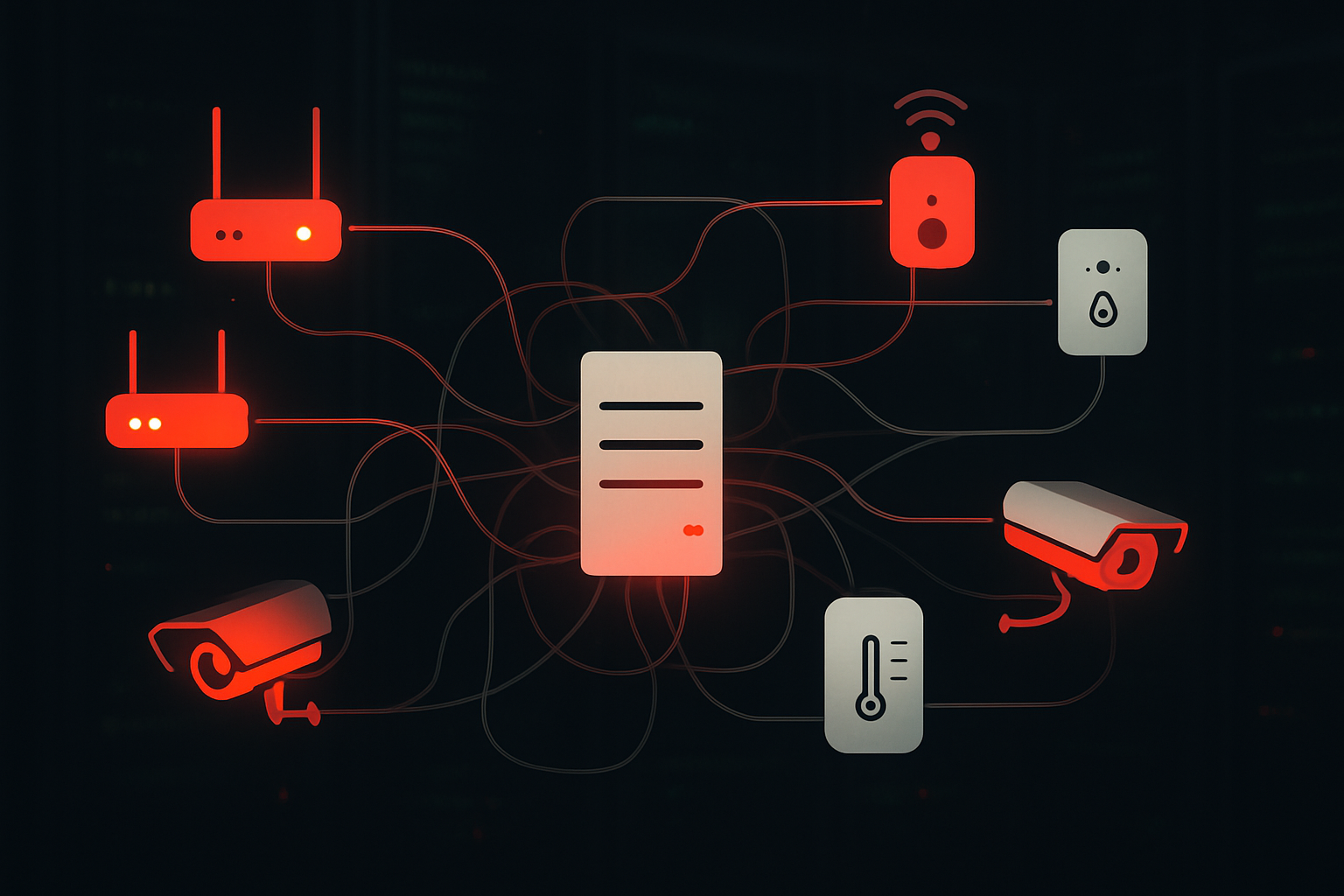
A new class of threat has emerged at the intersection of artificial intelligence and IoT malware development. Cybersecurity researchers have disclosed details of TuxBot v3 Evolution, an Internet-of-Things botnet framework that exhibits clear markers of having been developed with assistance from large language models. The discovery raises uncomfortable questions about how readily threat actors can now automate the creation of malware infrastructure.
AI-Assisted Malware Development and the Quality Problem
What makes TuxBot v3 Evolution notable is not just that it exists, but the mechanism of its creation. Rather than manually writing exploit chains and command-and-control logic, the developers appear to have delegated portions of the codebase to an LLM. The resulting code carries hallmarks of this approach: structural inconsistencies, incomplete error handling, and notably, residual safety disclaimers that the developers then stripped out or ignored.
This presents a peculiar security inversion. Conventional wisdom holds that AI systems generate inferior code, missing edge cases and containing subtle bugs. In the context of botnet development, those same weaknesses manifest as detection signatures, failed exploitation attempts, and communication failures that security teams can observe and block. An LLM that actually produces bulletproof malware would be far more dangerous than a competent human attacker. The current reality—where AI-generated botnet code is functional but flawed—creates an intermediate threat level: widespread, easy to produce, yet still vulnerable to pattern-based detection.
Infrastructure Implications and Hosting Risk
For infrastructure operators and hosting providers, TuxBot v3 Evolution illustrates a widening attack surface. IoT botnets require compromised devices to communicate with command servers, exfiltrate data, or participate in distributed attacks. These control channels frequently route through hosting infrastructure: dedicated servers, VPS instances, and even cloud services provisioned under false pretences or compromised accounts.
The rise of LLM-assisted malware development means the volume of botnet variants will likely increase. Where previously a single botnet framework required sustained development effort, threat actors can now generate dozens of variants with minor modifications, each potentially evading existing detection signatures. This creates pressure on hosting providers to implement more sophisticated network monitoring, anomaly detection on egress traffic, and rapid incident response protocols.
The IoT devices themselves—routers, cameras, industrial controllers, and embedded systems—remain the weakest link. Many run outdated firmware, lack proper access controls, and sit directly on public internet ranges. A botnet that can be generated cheaply and deployed widely will find plenty of targets regardless of code quality.
Detection and Response Challenges
One tactical advantage of the current generation of AI-assisted malware is that it still bears traces of its origins. Safety disclaimers embedded in generated code, redundant functions, and structural patterns recognisable from training data all serve as forensic markers. Security teams can use these artefacts to identify LLM-generated botnets, trace them back to particular model families, and develop countermeasures.
This window will close. As threat actors refine their prompts and learn to post-process generated code more thoroughly, the distinguishing features will disappear. The focus shifts to behavioural detection: monitoring for unusual network activity, command execution patterns, and resource consumption on compromised devices. For hosting operators, that means investing in network intrusion detection systems, flow analysis tools, and threat intelligence pipelines that can correlate activity across customer accounts and infrastructure.
The alternative—blocking or rate-limiting all IoT traffic—is impractical. Legitimate IoT deployments now constitute a significant portion of hosted infrastructure, from industrial telemetry to surveillance systems and smart building controls. The challenge is distinguishing command traffic for a botnet from legitimate device management or update mechanisms.
The Asymmetry of Effort
What TuxBot v3 Evolution demonstrates is an uncomfortable asymmetry. Defending IoT infrastructure requires continuous firmware updates, network segmentation, and monitoring across millions of heterogeneous devices. Generating a new botnet variant now requires only a well-crafted prompt and a few minutes of LLM processing. This disparity will drive investment in passive defences: network-level isolation, anomaly detection, and better visibility into device behaviour.
The disclosure of TuxBot v3 Evolution is less a one-off curiosity and more a warning that the commodity malware market is entering a new phase. Botnets will proliferate, variants will multiply, and detection will become increasingly difficult. Infrastructure teams should assume that IoT-focused threats will intensify and plan accordingly.