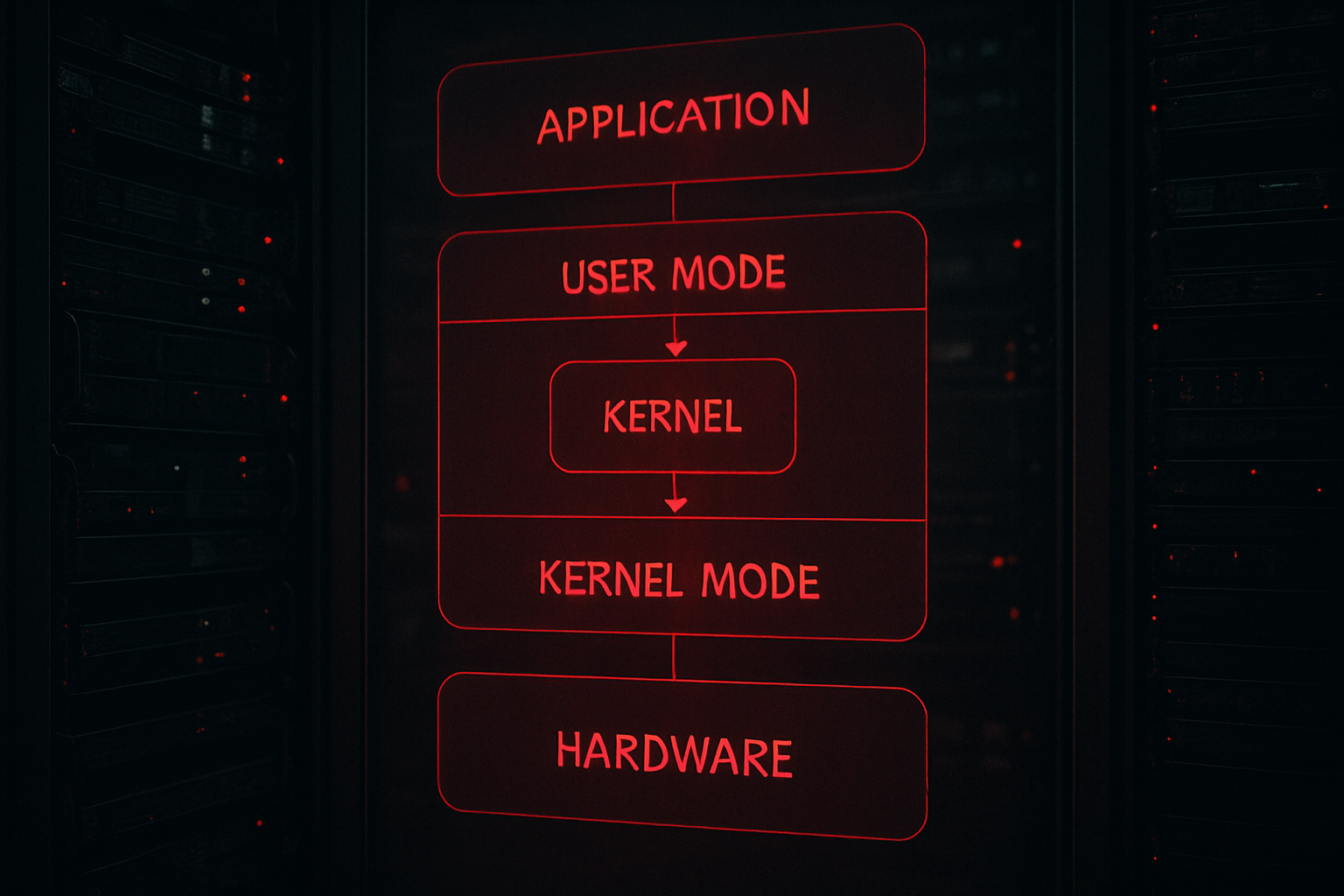
A malware distribution campaign targeting Ukrainian users has exposed a critical weakness in how endpoint detection systems operate: their vulnerability to kernel-mode exploitation. The Lunex stealer platform, discovered through analysis of Psychedelic Stealer malware, leverages a technique that many security teams overlook—abusing legitimate hardware drivers to disable monitoring at the kernel level.
Kernel-Mode Execution as an Evasion Layer
Traditional endpoint detection and response (EDR) solutions operate primarily in user-mode, monitoring process creation, file writes, registry changes, and network connections from a privileged but ultimately limited vantage point. Kernel-mode malware, by contrast, runs at a privilege level above these monitoring layers. By loading or abusing a legitimate AMD driver, Lunex gains access to kernel-mode execution without triggering the code-signing verification that might catch unsigned kernel modules.
This approach is not new in principle—rootkit authors have exploited driver vulnerabilities for decades—but the systematic integration into a malware-as-a-service platform represents an escalation. Rather than requiring sophisticated in-house development, threat actors can now purchase or rent access to pre-built kernel exploitation chains. The barrier to entry for conducting undetected credential theft drops significantly when the hard work of driver exploitation is commoditised.
The Attack Chain and Browser Credential Targeting
The four-stage infection flow begins with a deceptive CAPTCHA page hosted on compromised infrastructure, typically Ukrainian websites serving as distribution nodes. Users are directed through fake Cloudflare verification checks—a social engineering tactic known as ClickFix that exploits trust in legitimate security services. Once the victim executes the payload, subsequent stages progressively elevate privileges and load the malicious driver.
The ultimate objective is browser credential extraction. Modern browsers store passwords and session tokens in encrypted local storage, usually protected by the Data Protection API (DPAPI) on Windows. From user-mode, accessing these secrets requires either stealing the decryption key or leveraging browser vulnerabilities. From kernel-mode, the malware can read memory, tamper with running processes, or intercept cryptographic operations before encryption occurs. Browser credentials are high-value targets because they unlock email accounts, payment systems, and internal corporate infrastructure.
Detection Gaps and Infrastructure Implications
The success of Lunex highlights a fundamental problem in endpoint security architecture: the assumption that user-mode monitoring is sufficient. Many organisations, particularly smaller enterprises and those in regions with limited security resources, rely on EDR tools without supplementary kernel-mode visibility or driver integrity monitoring.
For hosting providers and infrastructure operators, this has direct implications. If a customer's server is compromised by credential-stealing malware, the attacker gains not just the customer's data but potentially the hosting provider's internal systems if shared credentials are in use. A single compromised managed server can become a pivot point into broader infrastructure. The lesson is that credential theft is not purely an endpoint problem—it is an infrastructure concern whenever privileged users or applications interact with hosted systems.
Mitigation and Monitoring Strategies
Kernel-mode evasion requires kernel-mode detection. Organisations should implement driver integrity monitoring, which alerts on unsigned or unexpected kernel modules. Windows Driver Attestation (available through Device Guard or Hypervisor-protected Code Integrity) can restrict kernel execution to signed, whitelisted drivers. Disabling or removing unnecessary hardware drivers reduces the attack surface.
At the browser level, credential storage isolation and encrypted sync to password managers reduce exposure if user-mode theft occurs. For infrastructure teams, monitoring for unexpected driver loading, unexpected kernel module imports, or processes accessing sensitive browser storage paths offers a practical starting point. Behavioural analytics that detect abnormal memory access patterns from system processes can catch kernel-mode theft in progress.
The detailed analysis from Ontinue underscores that commodity malware is becoming increasingly sophisticated in its evasion techniques. For security teams, the implication is clear: user-mode visibility is now table stakes, not a comprehensive defence. Kernel-mode threats require corresponding depth in monitoring, or organisations will remain blind to the most privileged attacks.