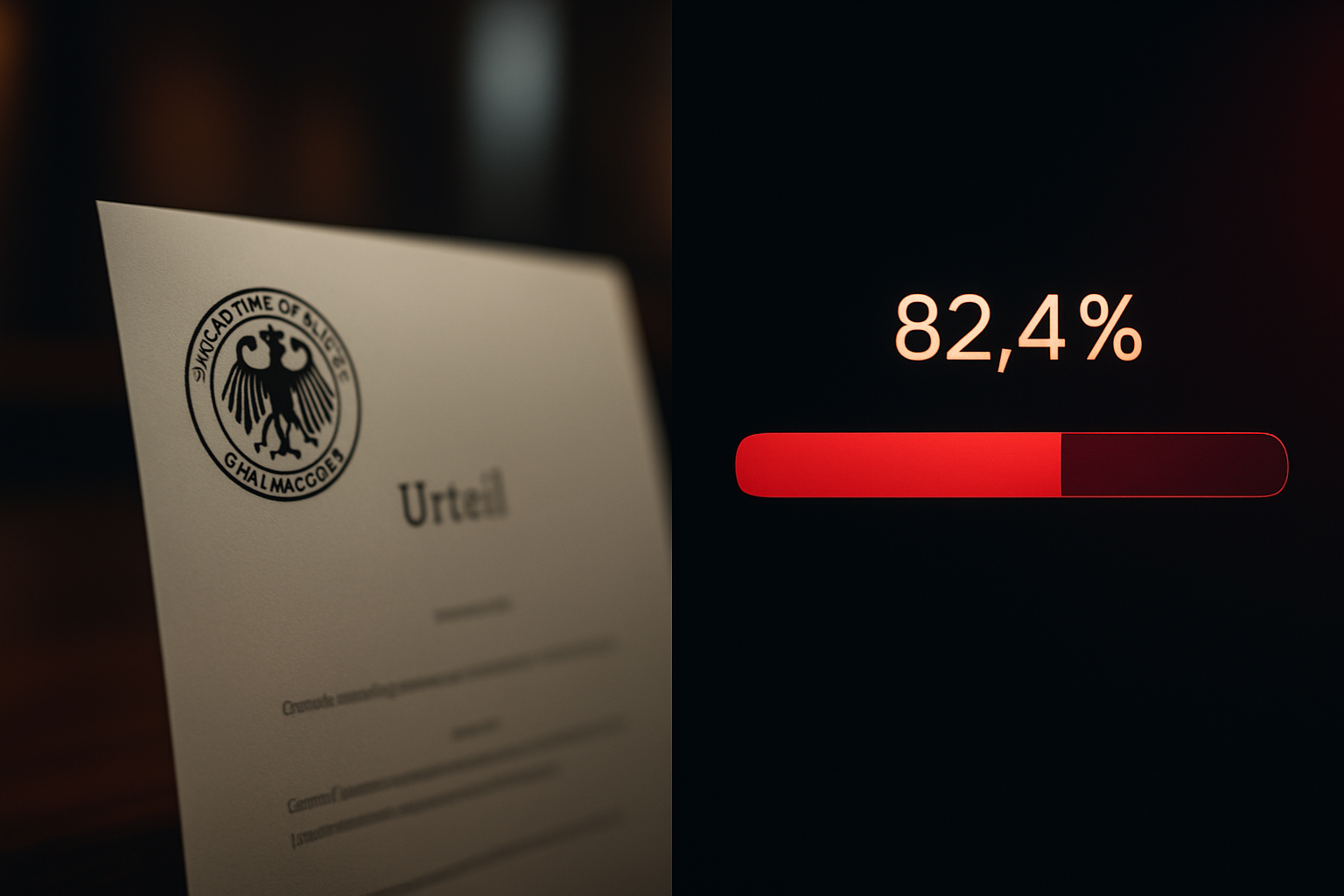
German copyright enforcement has reached a quantifiable milestone. A clearinghouse called CUII—which advises on site-blocking decisions—has effectively established that a hosting platform becomes structurally infringing when illegal content comprises at least 81.5 percent of its catalogue. The recent blocking of KinoGO, which crossed that threshold at 82.4 percent, suggests the legal boundary is hardening rather than remaining fluid.
How the Threshold Was Established
German law does not codify a single, bright-line rule for structural infringement. Instead, courts have developed a principle: when illegal material substantially outweighs legal material on a platform, the entire site becomes a target for blocking orders rather than individual content takedowns. CUII's 81.5 percent figure represents the practical floor at which German courts have begun to act decisively.
This is significant because it shifts enforcement away from surgical content removal and toward platform-level blocking. Internet service providers in Germany can be ordered to restrict access at the DNS and routing level, effectively removing the site from the German internet without requiring the hosting provider's cooperation.
The Padding Problem and Enforcement Gaps
The precision of the threshold raises a tactical question: could operators deliberately seed their platforms with legitimate, freely-licensed, or public-domain content to push the infringement ratio below the legal line? A streaming site that mixed pirated films with archival material or Creative Commons content could theoretically operate just inside the boundary.
In practice, this defence is fragile. Courts evaluate not just the raw percentage but the structural design of the platform—whether legitimate content is incidental to the core infringing catalogue, whether search and recommendation systems prioritise illegal material, and whether the operator's business model depends on piracy. A platform stuffed with legal padding is likely to be transparent to judicial scrutiny.
However, the existence of a quantified threshold does create an enforcement asymmetry. Platforms operating in jurisdictions without comparable numerical benchmarks face vaguer, case-by-case determinations. Germany's clarity, paradoxically, may make blocking easier to challenge on procedural grounds while making the rule itself predictable.
Implications for Hosting Infrastructure
For hosting providers and infrastructure operators, the German approach has two layers of impact. First, there is direct exposure: if your datacentre hosts a platform that crosses the threshold, German ISPs will be ordered to block it, but the hosting provider itself usually remains insulated from liability (though not always, depending on notice and response time). Second, there is indirect pressure. Payment processors, DDoS mitigation services, and DNS providers increasingly incorporate abuse-team guidance from enforcement jurisdictions, including Germany, which can lead to service termination even before a formal blocking order.
Operators offering offshore hosting or no-DMCA or DMCA-ignored options will likely see pressure to implement content filters or proactive moderation to reduce exposure in European markets. The 81.5 percent rule is a German measure, but it signals how enforcement bodies across jurisdictions are moving toward quantifiable, enforceable standards rather than vague principles.
The Broader Pattern
What makes this threshold notable is not the number itself but the trend it represents. Copyright enforcement is becoming more systematic and algorithmic. Rather than pursue individual operators, authorities are establishing clear metrics that enable automation and scaling of blocking orders. As more jurisdictions adopt similar benchmarks, hosting providers will face a convergence of compliance requirements that make operating platforms with mixed legal and infringing content increasingly untenable.
The KinoGO case also underscores a paradox in modern content hosting. Sites that publish terabytes of material find it nearly impossible to maintain a ratio that satisfies both copyright holders and legal permissibility thresholds. The 81.5 percent line is not a loophole for operators; it is a firewall for regulators, marking the point at which a platform stops being a hosting service with some infringing content and becomes, de facto, a piracy distributor.