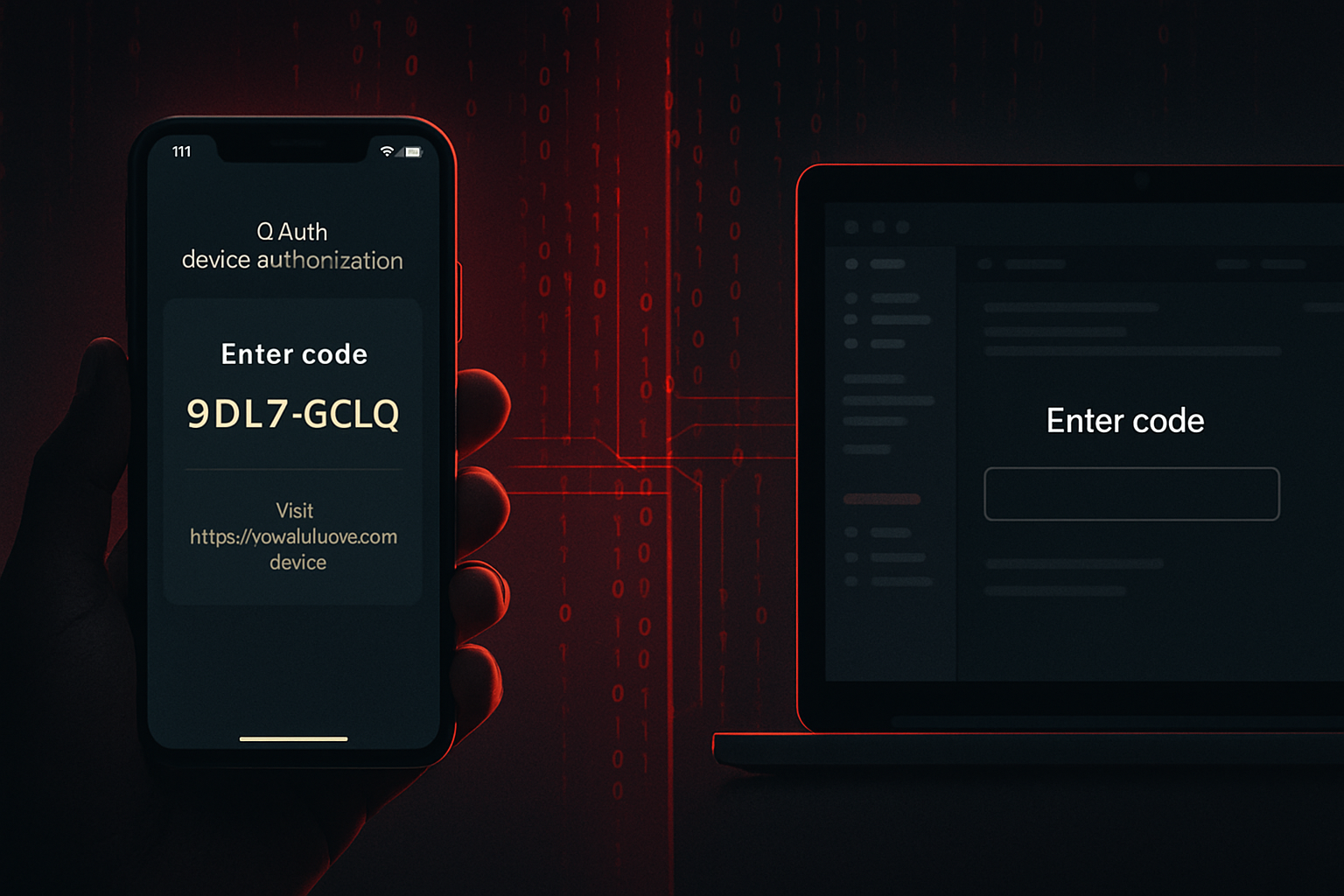
A new phishing-as-a-service (PhaaS) toolkit has begun advertising support for device code phishing, a technique that weaponises the OAuth 2.0 Device Authorization Grant standard to sidestep multi-factor authentication. For infrastructure operators and hosting providers, this represents a concrete authentication risk worth understanding in depth.
The Device Code Flow and Its Legitimacy
The OAuth 2.0 Device Authorization Grant was designed to solve a real problem: authorising devices with limited input capabilities, such as printers, smart TVs, or command-line tools. Rather than typing a password on a remote control, a user visits a separate browser to authenticate and confirm a device request. The flow is straightforward and, in principle, secure.
The user sees a device code on their television or terminal. They navigate to a verification URI on their phone or computer, enter the code, and authenticate. The device then receives an access token. This avoids exposing credentials to the constrained device and keeps the token exchange out of the device's insecure environment.
From a protocol standpoint, this design is sound. The problem emerges when the legitimate authorisation prompt becomes indistinguishable from a fraudulent one.
How Phishing Weaponises the Device Code Flow
Device code phishing inverts the trust model. An attacker initiates a legitimate OAuth 2.0 device code request on behalf of a target service—say, Microsoft 365 or Google Workspace. The victim receives a phishing email or message with a device code and a link to a verification URI. From the user's perspective, it appears to be a routine authorisation prompt.
The victim enters the code and authenticates at what they believe is the legitimate verification page. In reality, they have just approved an attacker's request for an access token to their account. Even if the user has MFA enabled, they often complete the MFA check as part of the normal flow, believing they are authorising a legitimate device.
The attacker now holds a valid access token. MFA has been bypassed not through technical exploitation but through social engineering built into the OAuth flow itself. The token grants access to the user's account without requiring possession of the second factor again.
Why This Matters for Hosting and Infrastructure
For hosting providers, datacenter operators, and infrastructure teams, this threat has immediate implications. Many platforms used to manage hosting accounts, deploy code, or administrate cloud infrastructure rely on OAuth-based authentication. If attackers can compromise admin accounts through device code phishing, they gain entry to critical infrastructure management interfaces.
An attacker with a stolen token to a hosting control panel, CI/CD platform, or container registry can provision resources, modify configurations, inject malicious code, or exfiltrate data. The impact scales with the privileges of the compromised account.
Additionally, if an infrastructure team uses GitHub, GitLab, or another OAuth-based service for deployment automation, compromise of a developer or operator account becomes a supply chain risk affecting hosted systems and customer data.
Mitigation and Detection Strategies
No single technical control will stop social engineering, but several practices reduce risk. First, organisations should educate users about device code phishing. Unlike traditional password phishing, these prompts appear legitimate because they often are—the attack is in their unexpected arrival. Alerting users that they should never receive unsolicited device authorisation requests is essential.
Second, enforce strict token lifecycle policies. Tokens from device code grants should have short lifetimes and require re-authentication for sensitive operations. Some platforms allow administrators to revoke all active tokens for a user account, a useful last resort if compromise is suspected.
Third, monitor unusual authentication patterns. A spike in device code authorisations or tokens being used from unexpected geographic locations or at unusual times warrants investigation. Logging and alerting on these events should be a standard part of infrastructure monitoring.
Fourth, use conditional access policies if available. Many identity providers now support rules that flag or block authentication attempts that deviate from normal patterns—different device types, geographies, or times of day. These can catch compromises before tokens are fully exploited.
Finally, consider restricting which applications and services can use OAuth device code flows. Not every user or team needs access to this flow type. Limiting it to specific use cases reduces the attack surface.
Looking Ahead
Device code phishing thrives because it exploits the gap between protocol legitimacy and user awareness. The OAuth 2.0 Device Authorization Grant is not broken; the attack works because users cannot visually distinguish a real authorisation prompt from a phishing one.
Identity providers are beginning to address this through in-app notifications and additional context clues, but adoption is uneven. Infrastructure operators should assume this threat will continue to mature and treat it as a component of their account security posture rather than an edge case. For teams managing sensitive hosting, cloud, or deployment infrastructure, educating staff about unexpected device code prompts and implementing token lifecycle controls are practical starting points.