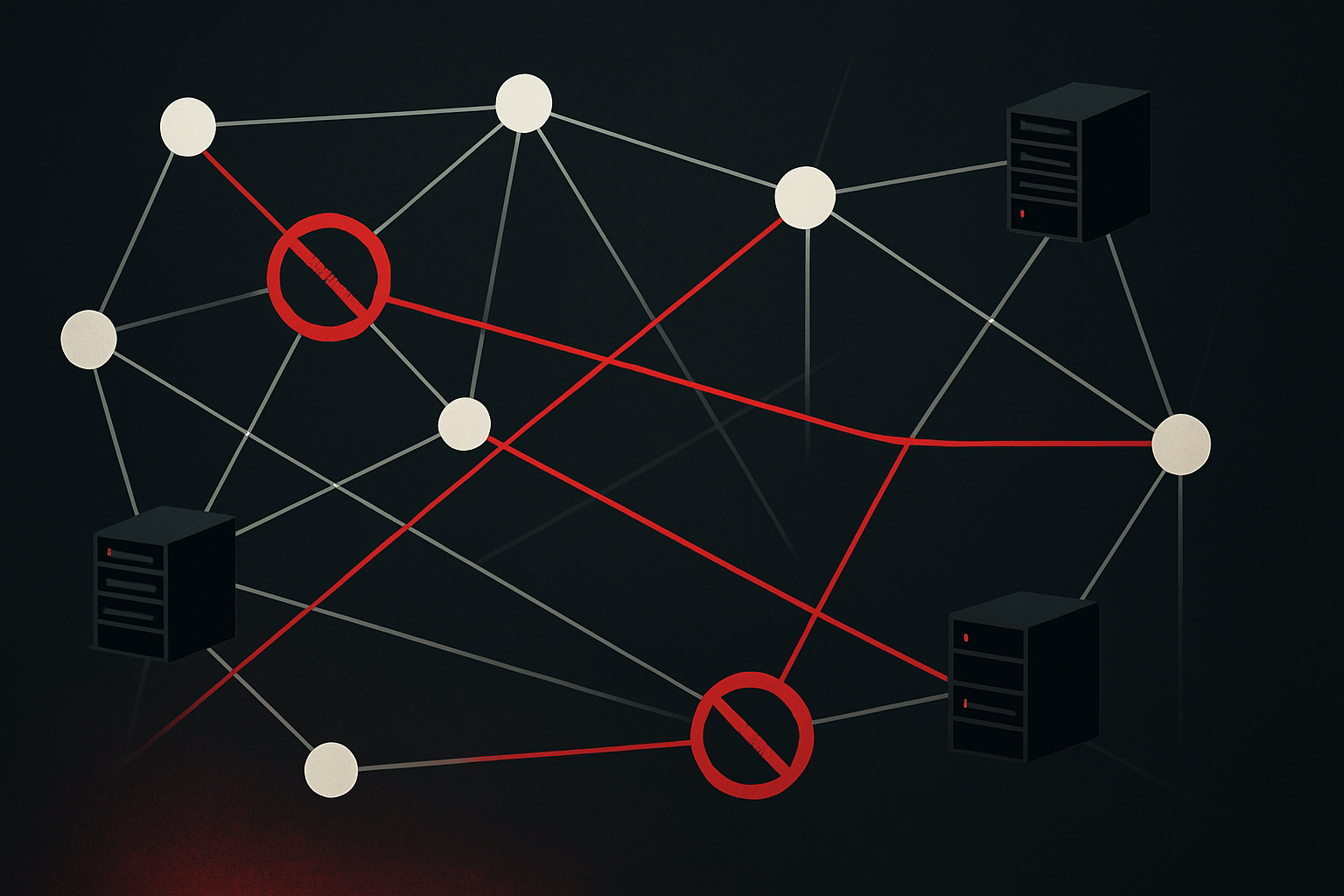
Sports broadcasting rights holders and copyright enforcement bodies have long relied on network-level blocking to prevent unauthorised streams. Yet as those systems grow more aggressive, infrastructure operators and technology groups are raising serious concerns about collateral damage to legitimate services, DNS resolution, and the fundamental openness of the internet.
The Overblocking Problem
Anti-piracy blocking typically works at one of three layers: DNS filtering (blocking domain names), BGP hijacking or route filtering (removing IP addresses from routing tables), or court-ordered ISP-level blocks at the transport layer. The theory is sound. The execution, however, tends to be blunt.
When a court order mandates that an ISP block a particular domain, the enforcement systems often cast a wide net. A single domain might resolve to shared hosting infrastructure serving thousands of legitimate sites. Blocking the IP address then blocks all of them. Wildcard blocks and pattern-matching rules intended to catch variant domains frequently catch innocent services instead. DNS filtering can poison lookups for subdomains, affecting automation and API calls from applications that expect standard resolution behaviour.
Tech industry groups including representatives from major infrastructure providers have documented these failures. The problem intensifies during high-profile events like the FIFA World Cup, when enforcement bodies deploy blocking rules hastily and without rigorous testing.
Infrastructure-Level Consequences
For hosting providers and network operators, overblocking creates genuine operational headaches. A legitimate CDN node or shared hosting account might suddenly become unreachable to users in certain jurisdictions without notice. Support teams field complaints about services that work in one region but not another. Administrators must debug DNS issues caused by third-party blocking filters they don't control.
The broader concern is architectural. The internet was designed as an open, decentralised system where any participant can route traffic and resolve names independently. Piracy-blocking systems, particularly when implemented inconsistently across multiple jurisdictions and ISPs, introduce a hidden layer of fragmentation. Content that resolves in one country doesn't in another. Services hosted in certain facilities become unreachable in certain regions for reasons unrelated to the service provider's own actions or compliance decisions.
This creates perverse incentives. Legitimate services may be forced to move to infrastructure in jurisdictions with lighter enforcement hands, or to acquire their own IP space and BGP announcements to avoid shared-hosting overblocking. Smaller providers simply absorb the cost or accept reduced availability in key markets.
The Standards Problem
A secondary issue is the lack of standardisation and transparency. Different enforcement bodies in different jurisdictions use different blocking mechanisms, with varying false-positive rates. No single source of truth exists for which domains are blocked where. Content delivery networks and DNS operators don't receive reliable upstream notification of new blocking rules; they discover blocks empirically when users report failures.
Some jurisdictions have begun imposing blocking obligations on DNS resolvers themselves—a particularly disruptive approach, since DNS is foundational infrastructure used by millions of legitimate applications. A misconfigured blocking rule at the resolver level can degrade experience for ordinary users trying to reach their bank, their email, or their employer's VPN gateway.
The Legitimate Hosting Question
For operators who provide hosting with strong privacy protections or broad content policies, the situation is complicated. Overblocking by third parties can degrade service quality and user experience without the provider's involvement. Yet providers who take steps to avoid shared-IP overblocking risks—such as offering dedicated servers, private IP allocations, or premium hosting plans—may find themselves suspected of enabling circumvention simply by providing robust infrastructure.
The underlying tension is real: copyright protection is a legitimate goal, but the mechanisms deployed often damage the open internet in ways that affect far more than their intended targets. Enforcement bodies acknowledge the problem in principle but rarely audit their blocking rules for false positives or retire obsolete blocks.
Infrastructure engineers and hosting operators who deploy services across multiple jurisdictions should expect this environment to continue deteriorating without intervention. Building redundancy, monitoring DNS resolution across regions, and documenting blocking incidents are practical mitigations. But the systemic issue—that anti-piracy enforcement lacks the precision and accountability of mature internet standards—remains unresolved.