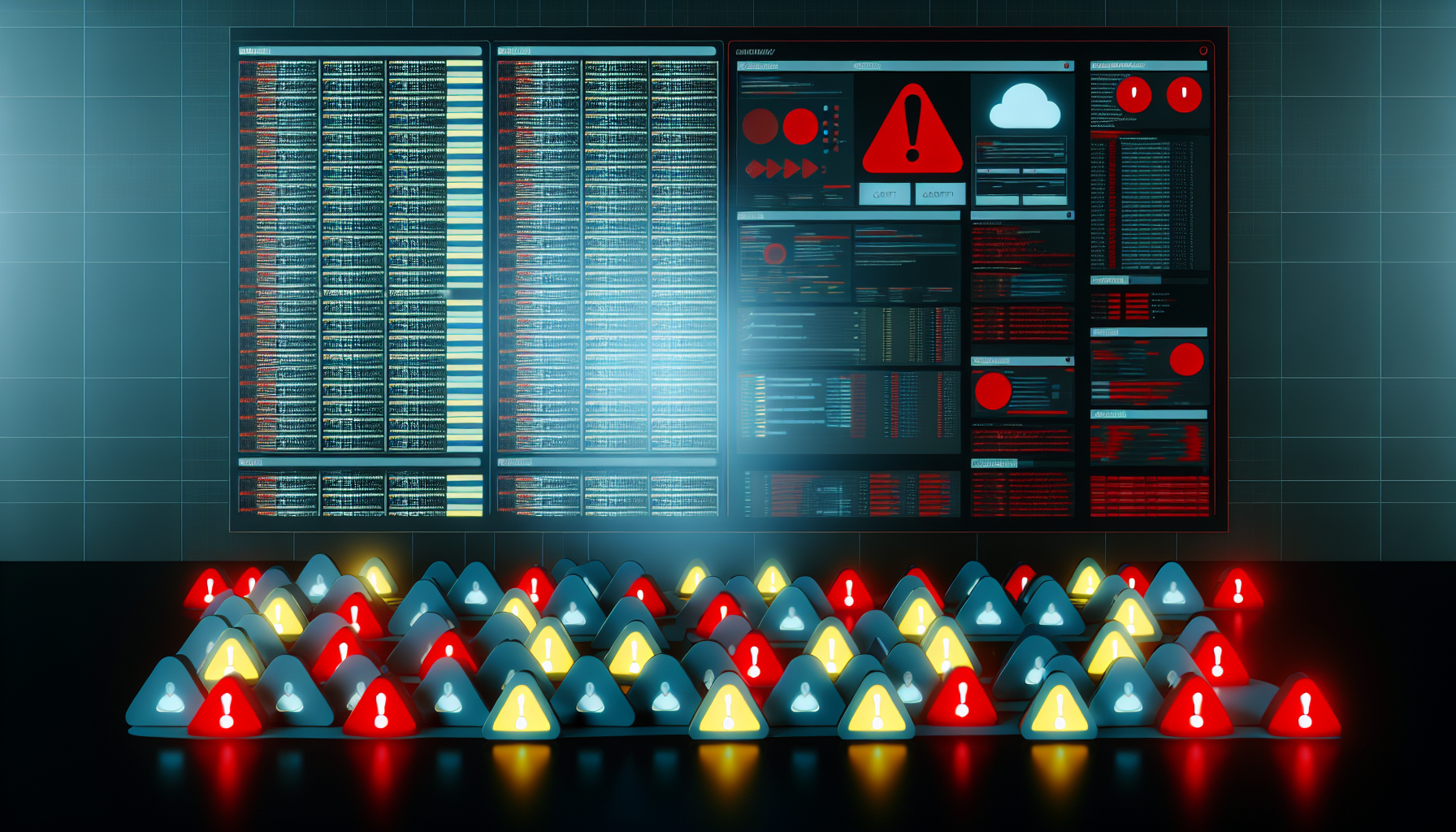
The volume of security alerts generated by modern infrastructure has reached a point where human attention is no longer the limiting factor. A recent analysis of over 25 million alerts across live enterprise environments reveals a sobering truth: defenders have begun systematically ignoring low-severity and informational events. The consequence isn't cleaner dashboards — it's missed threats.
The Scale of the Alert Problem
Enterprise security operations centres (SOCs) face an almost impossible triage problem. The sheer number of alerts — ranging from routine informational events to genuine security incidents — creates a mathematical certainty that something important will be overlooked. When a team receives thousands of alerts daily, many of them noise, the human brain defaults to pattern-matching and heuristic filtering. Operators begin to trust that low-severity labels are accurate, that informational events can be safely ignored.
The data contradicts this assumption. Among the 25 million alerts studied, significant threats were buried within the low-severity category with enough regularity that research teams documented a pattern: roughly one missed threat per week in a typical monitored environment. This isn't a failure of any single alert mechanism; it's a systemic consequence of scale.
For hosting operators and infrastructure teams, this pattern has direct implications. A VPS provider, dedicated server operator, or streaming infrastructure vendor managing customer environments faces similar alert volume. Each customer environment generates logs; security tools generate alerts; the aggregate becomes unmanageable without discipline.
Why Low-Severity Classifications Fail
Alert severity ratings are typically assigned based on the type of event, not its context. A failed login attempt might be rated informational. A certificate expiry warning might be low-severity. A port scan from an internal network segment might be informational. None of these tells you whether an actual compromise is occurring.
The problem deepens in multi-tenant or complex infrastructure environments. A misconfiguration that affects one customer might be low-severity at the network level but critical at the application layer. An unusual process execution might be routine in development infrastructure but a red flag on production systems. Static severity ratings cannot capture this context.
Many security teams respond by filtering aggressively, creating alert suppression rules that eliminate entire categories of events. This reduces noise in the short term but creates a systematic blind spot. Once an alert type is suppressed, it becomes invisible — both to humans and to downstream detection systems that might correlate it with other signals.
Building a More Resilient Alert Strategy
Infrastructure teams cannot solve this by hiring more analysts; the alert-to-analyst ratio is already untenable in most enterprises. The solution requires rethinking alert generation itself.
First, audit which alerts are actually used in incident response. Many organisations generate alerts that nobody acts on. These should be disabled, not suppressed. Disabling removes them entirely; suppression silently discards them and creates a false sense of coverage.
Second, implement context-aware severity assessment. A failed login from a new IP address to a user account that normally logs in once daily from a fixed location is higher risk than the same event for a service account that regularly authenticates from multiple sources. Alert tools should incorporate baseline behavioural data.
Third, establish alert correlation workflows. Instead of evaluating events in isolation, build detection rules that look for clusters of low-severity events that, together, indicate compromise. A single port scan is noise; twenty port scans from different sources to the same host in an hour might indicate reconnaissance.
For dedicated server and VPS providers, this becomes particularly important when securing customer infrastructure. A single customer complaint of slowness might be informational noise; but when correlated with elevated network latency alerts, DDoS detection signals, and CPU utilisation spikes, it becomes actionable. The alert system should surface this correlation, not bury it.
Practical Implementation for Hosting Operations
Teams managing hosting infrastructure should start by establishing baseline alert volume per environment. If a customer's VPS generates 50 alerts per hour, that's the baseline; 500 alerts per hour indicates a problem worth investigating, even if most are low-severity.
Deploy tuning cycles quarterly. Review alerts that were generated but never acted on. Eliminate those. For alerts that triggered investigations, measure whether they contributed to findings. Low-signal alerts should be disabled, not merely deprioritised.
Consider implementing escalation rules based on alert clustering rather than individual event severity. An alert that would normally be ignored becomes significant when it occurs in temporal proximity to other events. This shifts the burden from human analysts reading noisy dashboards to automated systems that can process thousands of correlations per second.
The analysis of 25 million alerts demonstrates that the current approach has reached its limit. The solution isn't better alerting systems generating even more data; it's disciplined filtering, context-aware scoring, and automated correlation that surfaces genuine signals from the noise.